US Retail & Consumer
Most recently, I suggested that Deck & Lulu looked attractive from a valuation standpoint. This week, I did some more in-depth work on DECK to follow up on.
Decker Brands’ stock is down about ~50% from its peak earlier this year (even after a 15% bounce last week), the long-term story for the company hasn’t really changed. While there are still real worries about how the business will do in the near term, especially around growth in the U.S, recent results looked a bit better in the last quarter as I picked up coverage and matched what management had guided us to.
To test management’s claim that they have “two of the healthiest brands in the global marketplace,” I did some more digging to checked how much they’re discounting compared to other popular brands that investors currently like. I also did some more work on that their sales channels in DTC and Wholesale for comparison.
The bearish argument on Decker really depends on profit margins getting much worse, and it is difficult to see given that they have managed inventories well and there just hasn’t been a collapse on demand – both of which, if true, would support this negative view. However, both their big brands in HOKA’s and UGGS inventory looks healthier than what the market expects – see below and seems to be well managed across retail partners.
Furthermore, management has increased investments into DTC stores, and in my view, there is still a lot of room left to open more stores – leading to more brand retention, better inventory control, and culture compared to peers that are rushing to open stores as fast as possible. That should also mean HOKA’s growth is more durable and sustainable over time.
Strong Inventory Management:

Company website data and channel checks, M2 Capital
This last weekend with black Friday being the emphasis of major sales, fairly all products were on sale – except for Hoka’s. I went into the Hoka store to see if any pair was on sale and there were none, with a very select few models. This contrasts with their competitor in ONON, where multiple versions of cloudsurfer 2’s that had also come out this year, but they were on sale across online channels for nearly ~20% discount. See for yourself – link ONON dicksporting goods vs DECK men’s Clifton 10s. Nike launched the Vomero 18 at the end of February. At Dick’s Sporting Goods, five colorways (men’s and women’s) are already on sale and that was apparent last week in Black Friday weekend, and four of those are widely available in most sizes.
This suggests that Decker’s has a solid level of control in their inventory management – which if I had to suspect will lead to continued steady healthy margins in the quarter ahead – for their newer franchises models that is. The same is true for some of their older models like the Bondi 8.

Company reports and websites, m2 capital
On the UGG side of things – while it is more difficult to gauge, as there are more skews. While I did see meaningful products on sale at places like Softmoc and Browns it was for specific Tasman I & IIs, but not all of UGGS were on sale – especially ones released this year. Which corroborates with the trend we have seen.
DTC vs Wholesale:
UGG’s direct-to-consumer (DTC) business is lagging, and while management says this is partly because wholesale partners have better inventory levels, it still raises some concerns about demand (perhaps some of the sales going on this past weekend). But still, I would argue that based on current valuation, investors could give benefit of the doubt.
Moving on to HOKA’s DTC performance. The company increased its store count by 41% (off a small base), but total DTC sales only grew 8% - while not the best, I believe there is a good tailwind for high growth as this channel has barely matured. Most of the sales on this channel are online but adding that many stores should still have driven a bigger lift — both in-store and online. Even so, growth did improve versus 1Q25, which supports management’s view that DTC should get better each quarter for the rest of the year.
The key takeaway however is that while the last two years have mostly been about expanding wholesale doors. Now, Deckers is saying the focus will shift a bit more back toward DTC. Their cautious approach to opening physical stores shows two attractive things about this company:
· There’s still a long runway for solid growth.
· Their best-in-class operating margins look more sustainable.
· No debt
· Trading at ~13x forward p/e
What really surprised me in this research is the disconnect in how investors are reacting. People are cautious about Deckers and worried about its near-term performance, but when you look at the comps, they seem much more relaxed about brands like Amer Sports, Vuori, and Alo. In my view, those brands are aggressively chasing growth by taking on a lot of risk with rapid physical store expansion, while Deckers is growing in a much more careful and controlled way.
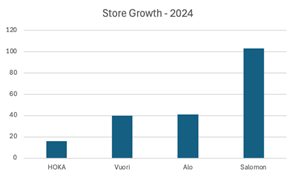
Company reports and online sales data, m2 capital: